
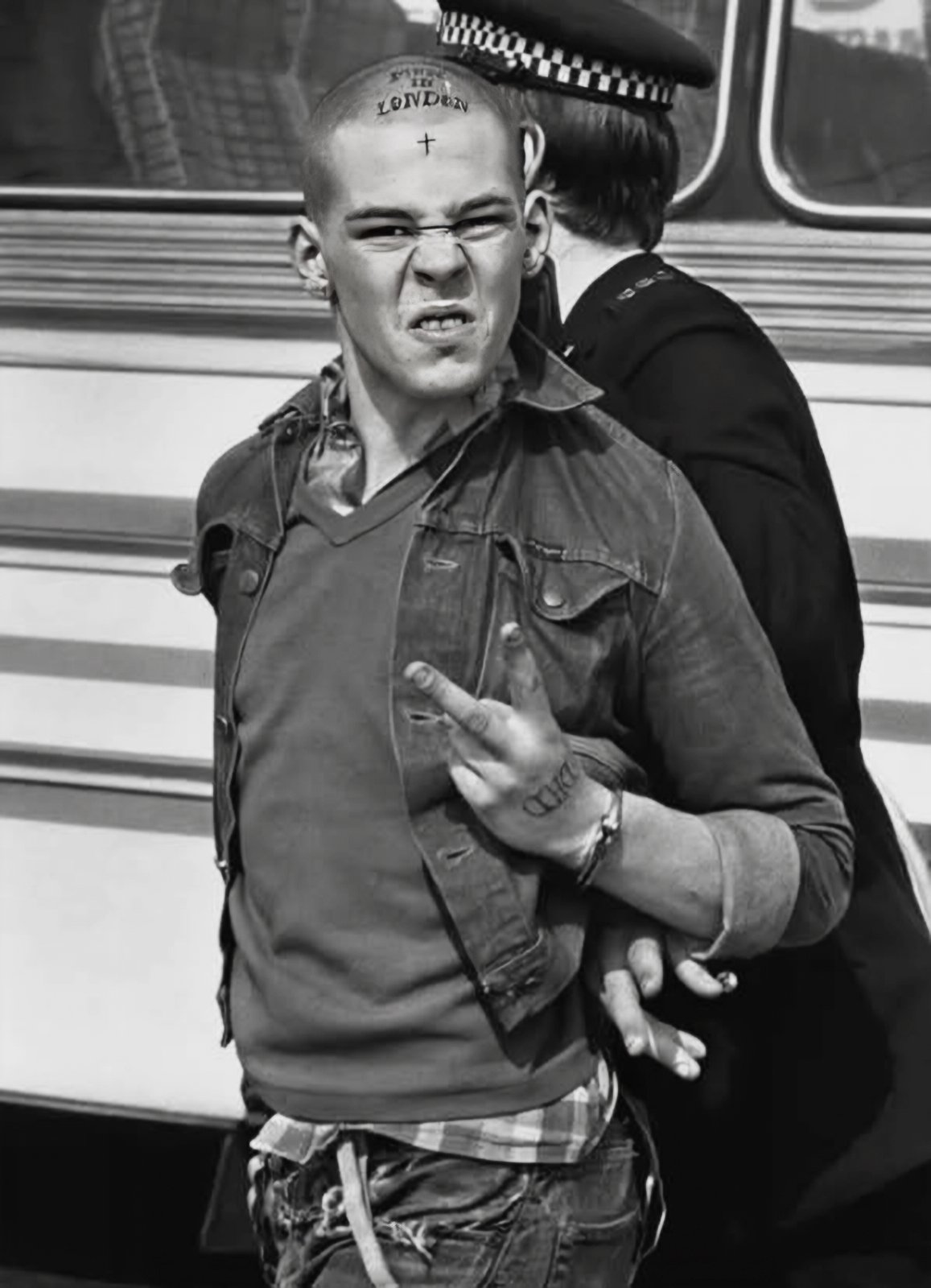
A skinhead is escorted away by a police officer in 1980. The words ‘Made in London’ and a cross are tattooed on his shaved scalp. (Photo by John Downing)
By the late 1970s and early 1980s, Britain’s streets had become a stage for identity, anger, and policing—especially in London. The skinhead subculture began in the late 1960s as a working-class style influenced by Jamaican ska and reggae, dock labor, and football terraces. Early skinheads weren’t defined by politics. But as Britain slid into recession—inflation hit double digits, unemployment passed 3 million by 1982—the look was increasingly pulled into confrontational politics. A visible minority aligned with far-right groups, while others remained apolitical or even anti-racist.
Public order laws expanded in this period, and police adopted tougher street tactics amid clashes at gigs, marches, and matches. Symbols inked onto shaved heads or knuckles became shorthand for belonging—sometimes national pride, sometimes provocation—read instantly by rivals and authorities alike. The look itself became evidence. By the mid-1980s, the culture fractured. Anti-racist skinhead movements emerged, punk and post-punk splintered scenes, and the original musical roots resurfaced in new forms. Added fact: he phrase “skinhead” peaked in British newspapers around 1979–80, then declined sharply, showing how quickly a subculture can be inflated, politicized, and exhausted by public attention.